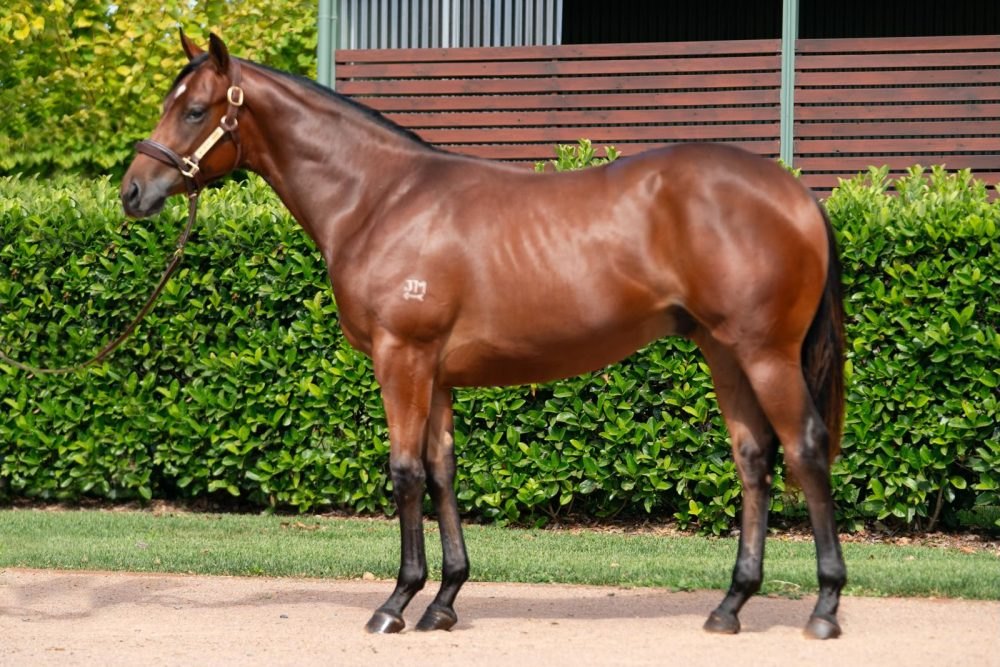
We’ve taken a share in another Darby Racing syndicate, which makes six horses running for us in Australia. This one’s a bay colt foaled in November 2024, by Stay Inside out of a mare named Sugar Mummy, and he’s already in work with Ciaron Maher at Warwick Farm. He’s a good-looking sort, plenty of horse through the shoulder and the hip.
The Colt
What sold us starts with his father. Stay Inside won the Golden Slipper, and if you follow American racing that needs a little translation. The Slipper decides the champion two-year-old in Australia. It’s worth A$5 million, and the entire juvenile season points at it the way ours points at the first Saturday in May. Stay Inside won it, was named champion two-year-old that season, and retired with A$2,247,600 in earnings.
Most first-crop stallions are still a story when their first yearlings hit the ring. Stay Inside already has stakes horses. Incognito won the Breeders’ Plate, Blue Door the Kindergarten, Lassified the Wellesley, and Eviction Notice ran second in the Silver Slipper, all in his first season with runners.
Our colt should be fast. His father sprinted, his mother won at 1200 metres, and the family behind her has been running 1000 to 1400 for three generations. His grandsire is Extreme Choice, one of the most productive stallions in Australia on a percentage basis despite having relatively small crops.
What we’re picturing is 1200 metres at Randwick on a Saturday afternoon, which is about as good as this sport gets.
He was foaled on 9 November, which makes him late. Every horse in Australia turns a year older on 1 August, so he’ll be giving away a few months to many of the colts he meets at two. We’re looking more toward the autumn of his two-year-old season, and we’re in no hurry. Maher will bring him along at the pace the horse asks for.
Why Australia
Some of you may wonder why the recent move into Australian racing. We’re based at ground zero for Thoroughbred racing in North America, after all.
The short answer is that we’ve come to love the Australian racing culture. The quality of the racing is exceptional, but it’s more than that. Racing matters there in a way that is increasingly difficult to describe to an American racing fan. It feels important. It feels current. And frankly, it’s contagious.
We’ve also been struck by how easy they make it to be an owner. The communication is good. The access is good. The bills make sense. Payments are simple. Information is readily available. You know what is happening with your horse and you feel connected to the process.
Those things sound small until you experience them together.
American racing, particularly given the questions surrounding its long-term health and the integrity issues that too often dominate the headlines, could learn quite a bit from the Australian system. They have managed to regulate the sport while still making it accessible, enjoyable and remarkably easy to participate in.
And people participate.
Melbourne famously stops for a horse race. The Melbourne Cup is a public holiday, more than 286,000 people came through the carnival last year, and the crowd at The Everest was the youngest a Sydney race day has ever drawn, with sixty percent under twenty-six.
The ownership numbers may be even more impressive. There were 12,039 syndicates racing last season with nearly 60,000 people involved in them, in a country of only 27 million. Ownership has grown substantially over the past decade, particularly among younger people.
That changes the whole feel of the sport.
Australians own racehorses in a way that feels closer to how Americans join fantasy leagues. You don’t need to be extraordinarily wealthy or already connected to the industry. The system is built to let an ordinary person buy a small piece of a horse and, if things go right, stand in the mounting yard on a Saturday with a real stake in what happens next.
We’ve felt that ourselves. Following horses from the other side of the world, getting the updates, watching the trials, learning the tracks and waking up to see how one ran has become a much bigger part of our racing life than we expected when we bought the first one.
The economics help too. The Everest is worth A$20 million, the Melbourne Cup and Golden Eagle A$10 million each, and there are more than 100 races on the Australian calendar worth A$1 million or more. Even ordinary racing offers meaningful prizemoney.
Then there’s the quality. Thirty of the world’s top 100 Group 1 races are run in Australia, and Australian-bred horses have dominated the international sprinting ranks for much of the last two decades. Asfoora was recently named European Champion Sprinter at the Cartier Awards, following Black Caviar and Starspangledbanner as Australian winners of the honour.
So yes, we still love racing here. Keeneland is home, and American racing will always be a huge part of our lives.
But Australia has gotten hold of us.
The colt is at Warwick Farm now, growing into himself. His first trial will tell us something. For now, we’re happy to let Maher take his time and see where the horse takes us.
Update, October 2026: the colt has been registered as Dr Feelgood and remains in work with Ciaron Maher.
All six of our Australian horses, who trains them and how they are going, live on one page.
Check Out Our Australian Stable